
Open evidence review: Heritage & Natural Environment
The Value of Agri-Environment Heritage Actions
Agri-environment schemes are the largest source of government funding for the rural historic environment. This is a self-initiated, open review of what the published evidence actually says about their wider co-benefits, for nature and for people, built on real public data. It maps where the evidence is strong, and where it is honestly thin.
Monuments analysed
2,206
Scheduled Monuments at Risk, 2024
Buried archaeology
85%
at risk from ground disturbance
Sources mapped
8
published studies and datasets
In brief
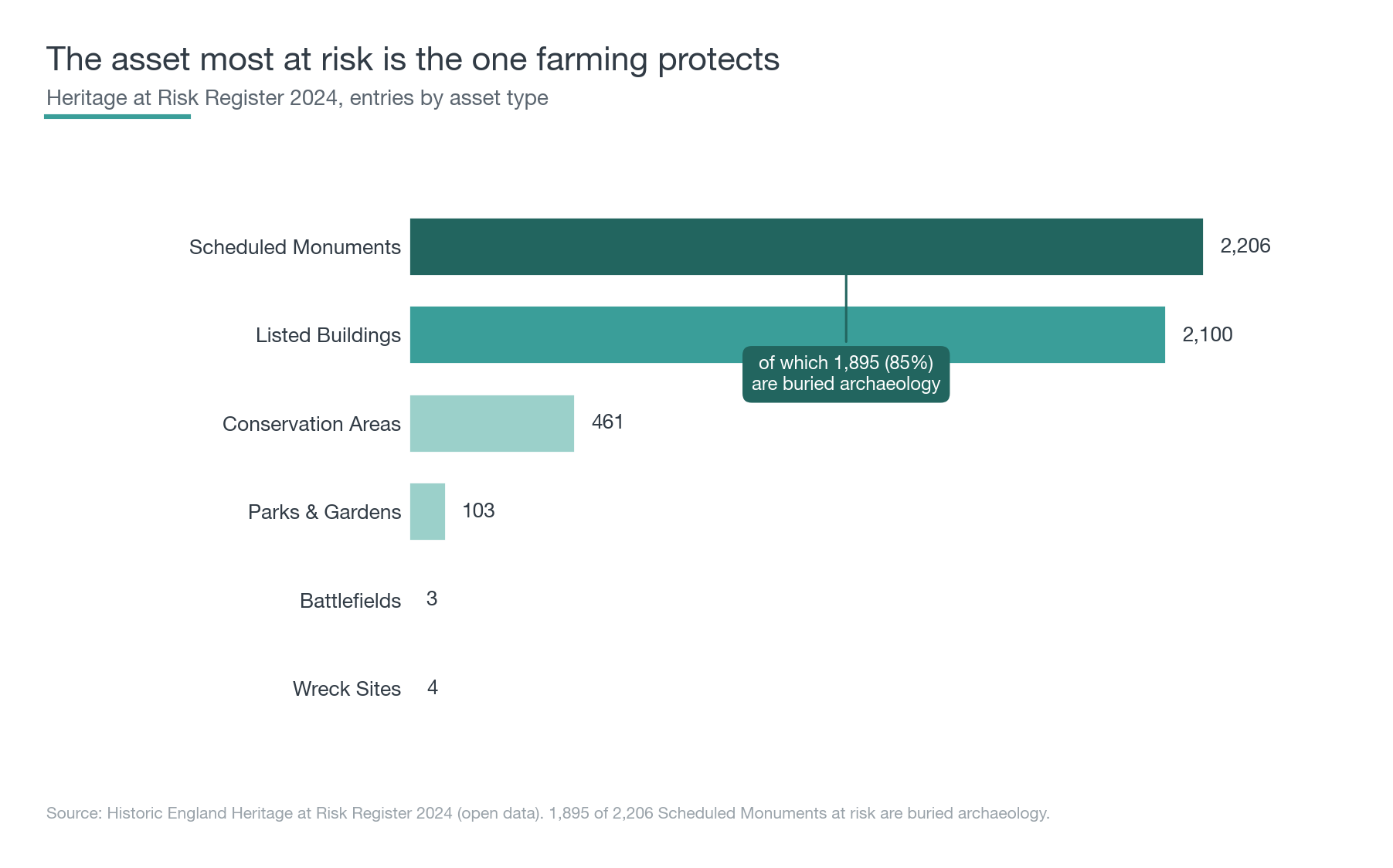
- 1.The risk is rural and buried. 85 per cent of Scheduled Monuments at risk are buried archaeology, and 84 per cent are on farmland, exactly what agri-environment actions manage.
- 2.The co-benefit evidence is real but uneven. It is strong for grassland, cultivation and water actions on carbon, biodiversity and water; it is genuinely thin for buildings and walls.
- 3.The value for people is the biggest gap. Across every action, evidence on access and wellbeing is the weakest, the single most important gap to close for a programme that is for nature and for people.
The Challenge
As nature recovery is delivered faster, at greater scale and under tighter budgets, heritage actions risk being overlooked unless their wider co-benefits for nature, people and the economy can be evidenced. Seventy-five per cent of Scheduled Monuments and all Registered Battlefields lie on farmland, and eighty-four per cent of Scheduled Monuments at Risk are on farmland, where the main pressure is agriculture or natural processes. The evidence for the co-benefits exists, but it is scattered across soil science, ecology, archaeology and grey literature. This review brings it together and shows the working. It is not a commissioned contract.
Where the risk is, and what is at stake
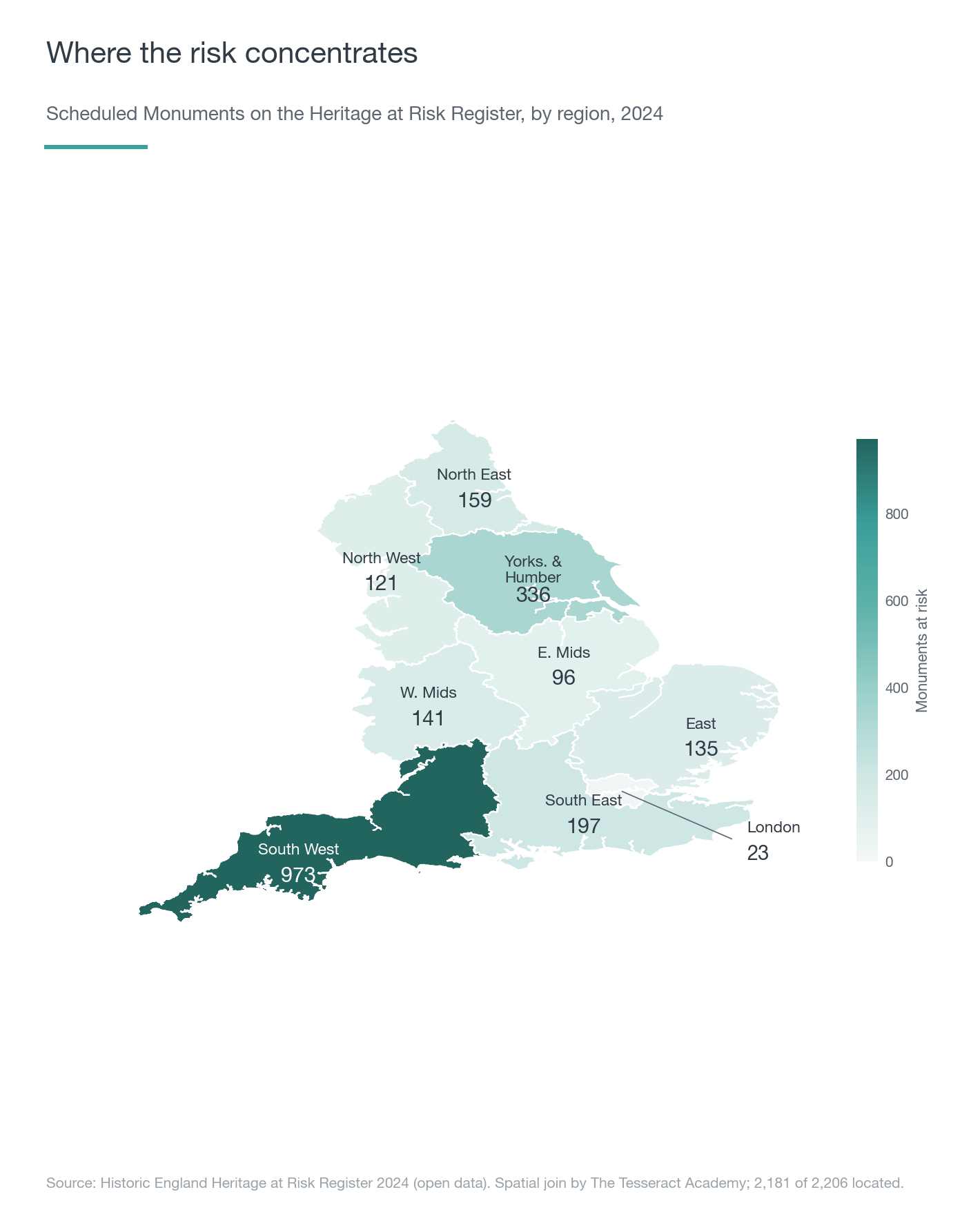
We took the Historic England Heritage at Risk Register 2024 open dataset and ran our own analysis. Of the 2,206 Scheduled Monuments at risk, 1,895 (85 per cent) are buried archaeology, the asset class most vulnerable to ground disturbance and precisely what agri-environment cultivation actions are designed to protect. A spatial join locates the risk by region: the South West holds 973 of the located monuments, which matches Historic England's own published figure of roughly 45 per cent of the register, a check that the analysis is sound.
What the evidence says, and where it is thin
We charted eight published sources (listed below) against the main heritage actions and co-benefit domains. The evidence is genuinely strong in places and genuinely absent in others, and an honest review says so.
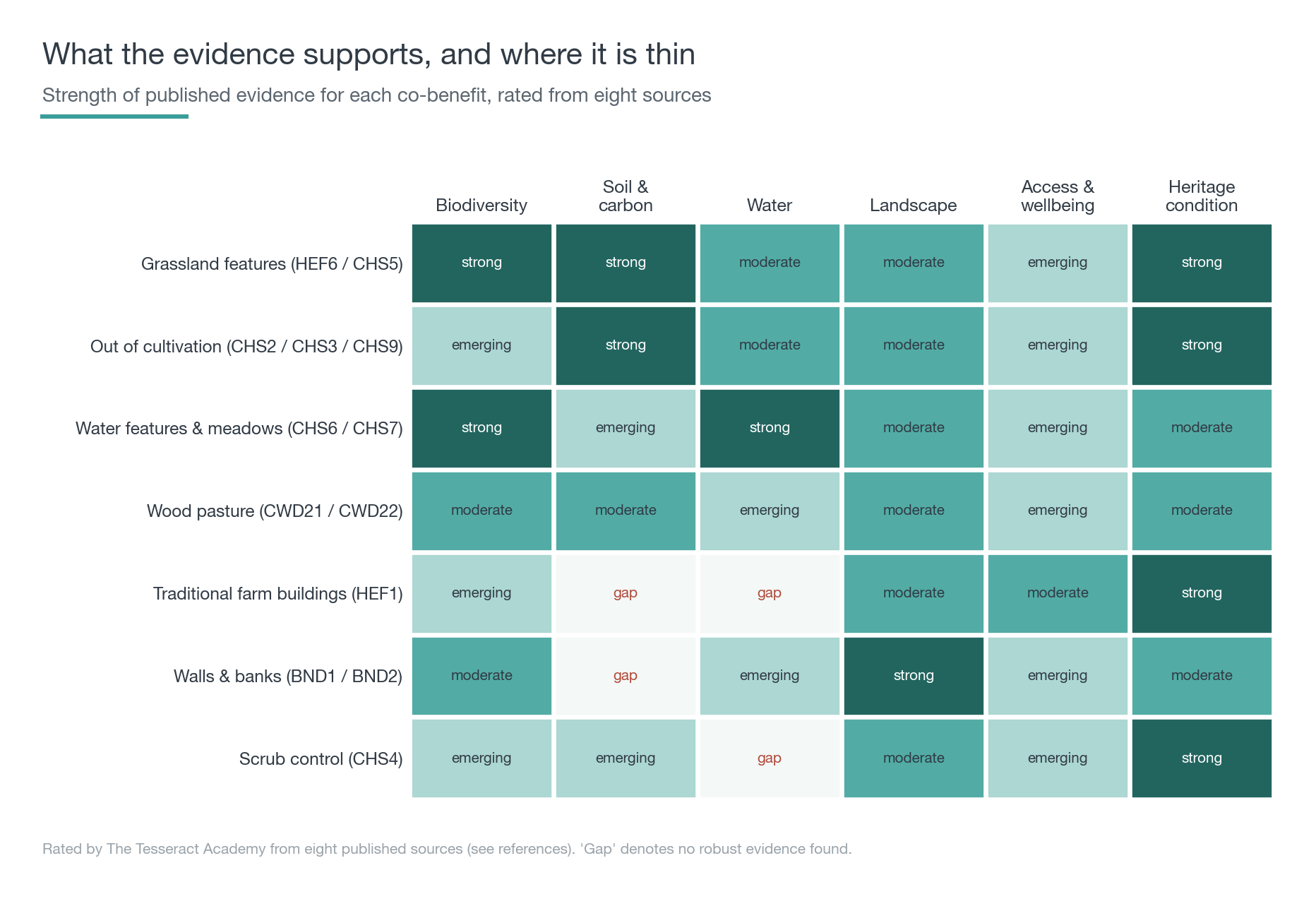
- Strongest where land stays undisturbed. Keeping archaeological features under permanent grassland, or taking them out of cultivation, has solid evidence for soil-carbon retention and heritage preservation: undisturbed soils store carbon and preserve the best-surviving earthworks, while cultivation levels them (the Damerham Iron Age dyke is the textbook comparison). Restoring grassland biodiversity is itself shown to accelerate soil-carbon sequestration (Yang and Tilman, 2019).
- Water features deliver for wildlife. Traditional water meadows and raised water levels have good evidence as habitat for breeding and wintering waders and waterfowl.
- Real gaps remain. The co-benefit evidence for traditional farm buildings, dry stone walls and earth banks is thin to absent, and the people-centred column, access and wellbeing, is the weakest of all. For a programme whose value is for nature and for people, that is the single most important gap to close, and naming it is part of the job.
Putting a value on it
Multi-objective benefits can be valued, carefully, using the HM Treasury Green Book and a natural-capital approach. The carbon component alone is real and quantifiable: using the DESNZ central non-traded carbon value (around £250 per tonne CO2e, 2020 prices), the carbon retained by not disturbing archaeological soil has a defensible annual value, to which water regulation, grassland biodiversity and the heritage asset itself can be added. Counting those benefits together, rather than a single outcome, materially strengthens the value-for-money case, and we are explicit about which benefits can be monetised with confidence and which are reported in physical or qualitative terms.
"A baseline of evidence is what lets a heritage action be defended on the strength of its multi-objective value, rather than lost under budget pressure. The job is to count the benefits that single-outcome accounting hides, name the gaps honestly, and show the working."
Tesseract Academy
Selected evidence
- Historic England (2025) Gaining an understanding of soil carbon and its management in an archaeological context. Research Report Series 50/2025. Link (opens in new tab)
- Historic England. Management of Archaeological Sites on Grassland (technical advice). Link (opens in new tab)
- Historic England. Grasslands: Nature Recovery and Heritage. Link (opens in new tab)
- English Heritage, ALGAO and Defra (2004) Farming the Historic Landscape: Caring for archaeological sites in grassland. Link (opens in new tab)
- Yang, Y., Tilman, D. et al. (2019) Soil carbon sequestration accelerated by restoration of grassland biodiversity. Nature Communications 10, 718. Link (opens in new tab)
- Conservation Evidence. Maintain traditional water meadows (including management for breeding and/or wintering waders/waterfowl). Action 696. Link (opens in new tab)
- Conservation Evidence. Raise water levels in ditches or grassland. Action 121. Link (opens in new tab)
- Robertson, D. (2020) HEFERs and SHINE data: outcomes for the historic environment. ALGAO / Archaeology East Anglia Report 47. Link (opens in new tab)
Method and full protocol: our pre-specified scoping-review protocol sets out the search strategy, eligibility criteria and charting framework in full.
Read the open methods note
The full pre-specified scoping-review protocol (PDF).
